By: Garrett Kilcer
In this post, I talk about the labyrinthian journey I took while researching Part 1 on this series.
I Slowly Lose My Mind
Welcome back for part 2 of the National Championship Series. If you have not read part 1, I highly recommend that you do so so that you’ll understand where I am coming from by the end of this post. Of course, you don’t have to read part 1 and if you’ve found this blog and this is your first read here, why would you start with something that has ‘part 2’ in the title? You fascinate me. With that being said, you should be able to follow along even if you haven’t read part 1.
As I said before, I did a lot of research into past College Football National Champions and how strange they can be at some points. To begin my research, I went to the NCAA website and found the list of all the National Champions. I did some initial data analysis including the rolling 10 year average chart that was on part 1 (That was a nightmare because I couldn’t figure out how to do the rolling average in excel or python (if you can then bully for you I guess) given that some years multiple champs were claimed so I did it out by hand. Because of that, some of the years may be incorrect but they are as close as I could get them without going insane. I mean, let’s be real, it’s almost 160 years of data).
Like any good data analyst hobbyist that is worth half his salt, I wanted to verify that the data that I had was correct and accurate. So I spot checked a couple of teams just to make sure they were claiming all the championships that were on the site. I checked a few like Alabama and Texas but something strange happened when I checked Texas A&M.
According to the NCAA, Texas A&M has won National Championships in 1919 and 1937. I went to the school website where they list out their championships and sure enough, those two years are listed under ‘Football’. What caught my eye however was that, wedged betwixt those two years, was the year 1927. Strange, I must have missed it on my excel sheet, I thought to myself. I go back to check my data and, sure enough, Texas A&M is not listed there. The schools that I have are Yale and Illinois. I figured I must have missed them when I copied over the data from the NCAA website but when I went back to check, clear as day, my data was validated by the information on the site.
Now I’m confused. Was two National Champions not enough for the year 1927? I knew that in 1919 there were four National Champions so a third one didn’t surprise me but why wouldn’t they list it? I had to go to the source of truth, a place that sifts through all the noise to get to the root of all things; Wikipedia. I found the page for the 1927 College Football Season and it lists all three teams I have mentioned as well as Georgia. But I can’t lose focus, I need to find out why Texas A&M has claimed themselves National Champions. There, in the second paragraph (which is just two sentences, I’m not judging but whatever) it says ‘over a half-century later Jeff Sagarin, a computer-based selector, named Dana X. Bible’s Texas Aggies as the No. 1 team.’1
What? Some guy said they were National Champions 50 years after the fact and they just threw it on their website? What kind of crap is that? So I followed their reference and the data on that reference doesn’t go further back than 1936 so I felt that something had gone wrong. A guy can’t just give a team a National Championship, right? I went to Jeff Sagarin’s website and sent him an email asking him what was going on with the 1927 National Championship and the email bounced back at me. I needed to keep searching for other dubious claims.
The next two schools confused me even more. I looked into Notre Dame and Penn State to see if they claimed any National Championships that were not on the NCAA website. Here I found something truly perplexing. It wasn’t what was on their websites that confused me, it’s what wasn’t there. Notre Dame does not claim the 1919 National Championship on their website and Penn State does not claim the 1911 or 1912 National Championships on theirs. This is the complete opposite of claiming an erroneous Championship; it’s actively disregarding one that the governing body of the sport recognizes.
I felt like I was going crazy. Sometimes the NCAA matched what the schools claimed and sometimes they wouldn’t. I just wanted to research how many more unique champions we will have and now I feel like I have fallen into a rabbit hole and ended up in Wonderland where nothing made sense anymore. In order to try and get a handle on things, I decided to continue to look at claims from schools so naturally I ended up in Minnesota.
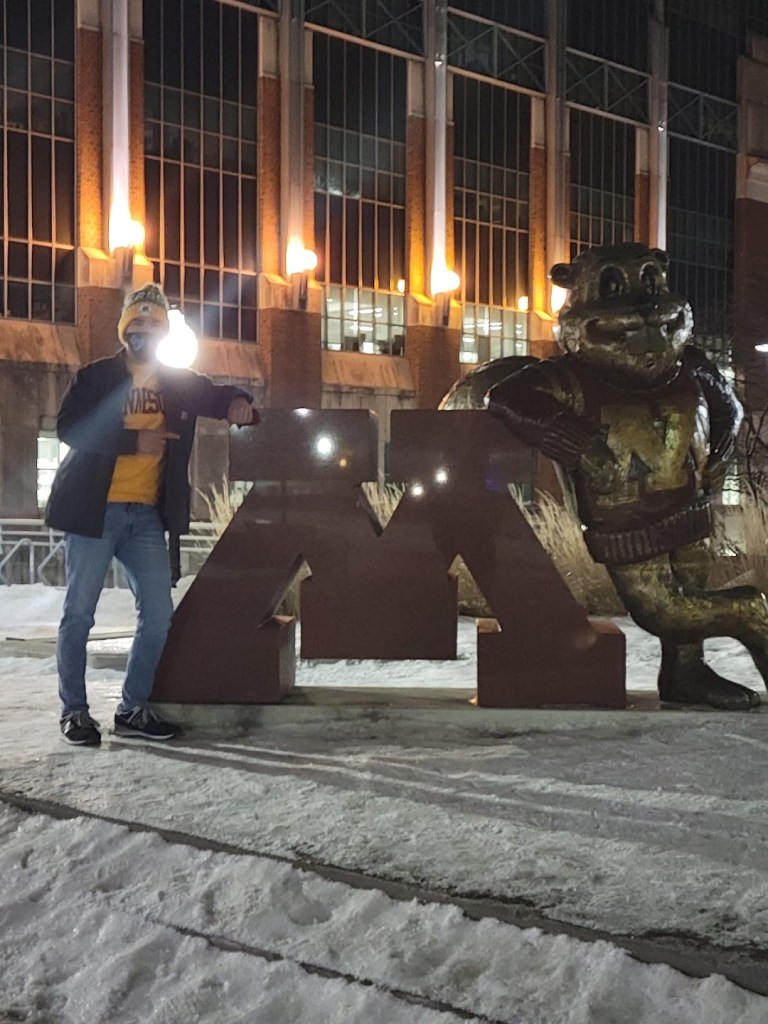
Here on the Minnesota website I found a piece of information that shined a light onto what I was dealing with. It did not answer all my questions. Even as I write this now, I have unanswered emails out there to various members of different schools. Emails that I doubt I will ever hear back from but would give me the clarity that I need. Regardless, on Minnesota’s website I noticed that they claim to have won the National Championship in 1904, a year not recognized by the NCAA. For this team they have a small write up and in this write up they say, ‘The Gophers were awarded the 1904 national title by Billingsley while Michigan and Pennsylvania were given national titles by other organizations retroactively. All national titles prior to the beginning of the Associated Press wire poll in 1936 were decided retroactively by math formulas or historical resource groups.’2
Boom! There it is! If you read my last post you’ll remember that I said that the AP Poll started in 1936 well this is where I found that out. Now I know that everything before 1936 is bound to be madness. Anyone who throws together a model and claims a team to be #1 means that they won the natty that year.
This Billingsley intrigued me. Who or what is Billingsley and how do they have the power to bestow a National Championship onto Minnesota? I went searching (googled it) and I found the website of one Richard Billingsley from Hugo, Oklahoma. There he had listed out every team that his model has picked as the National Champion ranging back to 1869 just like the NCAA website. I check and I see that, indeed, he chose Minnesota as his Champion in 1904.
But wait, what’s this? Do my eyes deceive me? It looks like he has listed Minnesota as National Champions in 1911 and 1915. Curiouser and curiouser! Why would Minnesota claim a National Championship, granted to them by Richard Billingsley, in 1904 but not in 1911 or 1915 by the same guy? I reached out to the school and must have gotten a student who did not know the answer. I then reached out to Randy Johnson of the Star Tribune but I have yet to hear back.
I figured that while I was on Richard’s site (called the College Football Research Center or CFRC) I should look at some of his other pre-1936 Champions. I saw a few of the usual suspects like Georgia Tech and Michigan but then I saw a team that I was delighted to happen upon; the Iowa Hawkeyes! Richard claims the Hawkeyes to be National Champions in both 1921 and 1922. So I decided to go to their website to see if they claimed their (newly found to me at least) Championships. I searched and searched but could not find any mention of winning these Championships in the early 1920s. This really bugged me because Iowa is in the same conference as Minnesota. If the Gophers can claim titles bestowed upon them by Billingsley then they should too.
I had already been on a roll emailing people that day (getting no response but a roll nonetheless) so I decided to email John Steppe who reports on the Iowa Hawkeyes for The Gazette. To my luck, he responded to my email! He said that Iowa recognizes their two National Championships in their media guide. I went to check the media guide that he sent me and on page 149 of that 320 page behemoth, he was right. Why would they hide it there while Minnesota has ‘1904’ in the stadium as a year where they won it all? I do not know. If it is plastered all around campus and I am unaware then, good for them but, as it stands, I do not know why they made it so hard to find.
More About Ratings
As my research continued, I felt myself gravitating back to the computer ratings that I so often crossed paths with. The ratings were the source of truth for these universities that claimed National Titles well before we even had a television to watch the games. The same names kept popping up; Sagarin, Billingsley, Dunkel. I needed to know more and that’s when I stumbled upon a fact that seemed to be staring me in the face the entire time. A truth so self evident that even saying it now feels foolish. These are the mythical computer ratings that were used in the BCS Championship era to decide the best teams.
How could I have not connected the dots sooner? I am writing a piece on National Champions. I know that the BCS era was decided with factors including but not limited to, computer ratings. I then find mythical computer ratings that bestow championships to schools in the years before World War 1. Somehow I needed an article from ESPN in the year 2000 to spell it out for me. At that moment, I swear I could feel my air conditioner blow air into my right ear and directly out of my left.
Herein lies the truth of the ratings, they were really good. Brad Edwards who ESPN dubbed as “one of the few people who actually understands the BCS” (come on ESPN, you’re the worldwide leader in sports) wrote back in 2000, “Last year, pollsters eventually overlooked Wisconsin’s loss to Cincinnati, but the computers didn’t. The result: the Badgers had an average computer rating of 7.71 despite ranking fourth in both polls.”3
Why We Watch
While researching I thought that the natural conclusion to this post would be that I would create my own rating system (and I still might) but I felt like there were a lot of questions that I couldn’t answer. What does it mean to have four National Champions in a year? What decides a National Champion at all? Even now, with our expanded playoff, sure, Ohio State was the best team in the nation. If you watched the games, it was clear. But did they have the right to play for a National Championship? They had already lost two games (including to their rival) and didn’t even appear in their conference championship game.
Somewhere along the way, I felt as though I lost the plot of college football. That was until I read Richard Billingsley’s page on his site titled “In Search of a National Champion”. In that post he said:
“I have tons of respect for my former BCS counterparts; Jeff Sagarin, Jeff Anderson, Chris Hester, Wes Colley, Kenneth Massey, and Peter Wolfe who are all light years ahead of my mathematical skills. But my system is not about mathematical algorithms. It’s about rules created to compliment a common sense human response to a football game. The BCS computer pollsters come from different perspectives, and we all believe strongly in our positions, but we all have a healthy respect for one another. I would argue their right to stand up for their position as much as I would my own. I’m proud to call them my friends. We all have stories to tell, this just happens to be mine.”4
What jumps out to me here is how personal it all is. Naming off all of his fellow colleagues, his argument that he tried to “compliment a common sense human response to a football game”, and that he called them all his friends. I think when we talk about college football a lot, the human aspect of the game gets lost in the shuffle. A lot is made about NIL budgets and player salaries, expanding playoffs or conferences, the transfer portal, or the professionalization of college athletics altogether.
We are focused on winning the National Championship and being the best team of all time but, as previously highlighted, most teams will never reach those heights. Does that mean all of their efforts, all of those players’ struggles are worthless? If a running back has a great senior year but doesn’t get drafted, was it all for nothing? What is left for those of us that are fans of teams that have the longest of odds to even make the playoffs?
I realized a while ago that the University at Buffalo, while technically eligible, will never compete for the National Championship. I had to shift the goal posts (pun intended) to what a successful season meant for me. I think any season in which we win a bowl game or a conference championship is a great season for the program. If I go into every season hoping to go undefeated and make the playoff, I’ll be disappointed every year. Much like the Newcastle United fans at the beginning of part 1, sometimes fifth place is a great achievement and should be celebrated as such.
I think that’s why we watch the sport. We don’t watch the sport to see who is the best team. Of course, these conversations will eventually arise; however, if that’s all we cared about, we’d start the playoffs at the beginning of the season and skip the rest. This sport teaches us about life because it is not about the destination but it is about the journey we take and the people that we meet along the way.
The connection that you feel with other fans celebrating a win or the support you get after suffering a brutal defeat. It is not dissimilar to celebrating a friend’s wedding or comforting them over a lost pet. The joy of watching your true freshman wide receiver run a great route that gets you excited about what he can and will become in the coming years is much like seeing your child play tee ball for the first time. These things are what connect us to the sport, this is why we watch.
So should we stop caring about National Championships all together? Probably not but we should focus on the other things that make this sport and others great. It’s about the community it fosters and the memories that it leaves us with.
Acknowledgments
While researching, CFRC posted a blog that said Richard Billingsley is experiencing health issues. I wanted to dedicate this to him. Even though he’ll probably never read this, I think it should be said that his love for the game is palpable and the work he has put into it in the past 55 years is incredible. I wish him all the best because he, much like myself, is just a guy who loves college football.
I want to thank John Steppe for answering my email. It means the world to me. Answering my email did not gain him any notoriety or further his career and yet he took time out of his day to help. Just one college football fan helping another. You can read his work here: https://www.thegazette.com/john-steppe/
I must again sing ESPN’s praises. This is the second time that I have made fun of ESPN in the post and then complimented them afterwards. It amazes me that they still have that old BCS article up on their site. It’s a true testiment to their preservation efforts. It would probably save them money to take it down and yet it persists.
1: https://en.wikipedia.org/wiki/1927_college_football_season – Wikipedia article of the 1927 College Football Season
2: https://gophersports.com/sports/2018/5/21/sports-m-footbl-spec-rel-1904-champions-html – University of Minnesota 1904 National Chmapionship Page
3: http://www.espn.com/ncf/preview00/s/2000/0811/679200.html – ESPN’s BCS Article
4: https://cfrc.com/in-search-of-a-national-champion – Richard Billingsley’s site but more specifically his article on his mentality behind the ratings
Here are some of the links that I talked about but didn’t explictly quote:
https://archive.org/details/iowa-football-2024-media-guide/page/149/mode/2up – Iowa Hawkeyes Media Guide
Notre Dame National Championships – https://fightingirish.com/nowhere-but-notre-dame-national-title-history/
Penn State National Championships – https://gopsusports.com/trads-national-champions
Texas A&M National Championships – https://12thman.com/sports/2021/11/12/texas-am-national-championships
NCAA National Championships List – https://www.ncaa.com/news/football/article/college-football-national-championship-history
Jeff Sagarin’s Website – http://sagarin.com

 Superfluous Analytics
Leave a comment