By: Garrett Kilcer
In this post, we take a dip into the shallow end of the history of College Football National Champions to try and see into the future of the sport. I throw some terminology around here that some people who are not super familiar with college football may not understand. The highest level of Division 1 College Football is called the FBS. ‘Power 4 Conference’ or ‘Power 4 School’ are the conferences of the SEC, BIG 10, ACC, and BIG 12 and the schools within them. ‘Group of 5’ are the other conferences; American, Sun Belt, Mountain West, MAC, and Conference USA (and sometimes the PAC 12). The Power 4 and the Group of 5 are both contained within the FBS and the schools that belong to them can all win the National Championship, technically.
The American Dream?
If you were a European ‘football’ fan, you would look at American sports with confusion and befuddlement. The way our leagues are set up, the primary focus is to win it all. All as in everything, to best everyone, and to leave no trace of doubt in anyone’s mind who truly is the winner. In the MLB teams are playing for the right to win the World Series, the NFL has their remaining gladiators duke it out in a Super Bowl, and the NBA’s final round of playoffs is simply called The Finals.
Words like super, world, and final cast a certain image in a person’s mind. In America, we are infatuated with the fact that a scrappy underdog can come from nothing and take out the perceived best in all the land, not unlike the New York Giants who stared down the unbeaten New England Patriots and left the game with the Lombardi. That’s why the draft is so much fun because we give the teams that have had the toughest go at it, great young players and hope they can single-handedly turn around a franchise.
The same can be said the other way around, however European sports would seem backwards to an American. Case in point, this year on the last day of the English Premier League, Newcastle United celebrated in front of their home fans after losing 1-0 to finish 5th on the table (that’s the standings for my Western audience). Any red-blooded American would be disgusted and probably quote the great Ricky Bobby who so eloquently put it, “If you ain’t first, you’re last.” Finishing 5th in this case is actually a great achievement for the club since that granted them a position in the Champions League which is the most prestigious soccer competition in the world.
In European football, the best young players do not get dealt out to the worst teams. The best young players go to the clubs with the purses that are big enough to pay their salaries. The worst teams in the league actually get kicked out and replaced. There is no dignity in losing, no tanking, and certainly no draft lottery. The best teams get put in the most advantageous positions to win even more which leads to similar teams staying at the top. These are your Real Madrids, Liverpools, and Bayern Munichs of the world. If that sounds familiar to you, that’s because we have something on our side of the pond that mirrors this format.
I love college football. An ideal Saturday in the fall for me would be in front of the tv from 9am until 1am the next day watching every game that I can. Following the scoreboards and all the plays. My girlfriend… does not see it exactly the same way. I love the pageantry and the rivalries. I love the crazy scores, insane traditions, and seemingly random trophies that teams play for.
I started watching college football a little bit while I was in high school and then when I went to college at Buffalo, I followed it a little more, but still leaned more towards the NFL. It wasn’t until I graduated college that I really understood the fun that was to be had at the collegiate level of the game. Being the late adopter that I was, the history of the game eluded me. My parents were not big into college football as I grew up and none of my friends watched it either so there was no one to show me the ropes.
I started following college football personalities and, reading more, I started to look at old stats and learned about the past greats. But what really gave me the reality check was the past National Champions. I knew that we did not always have the most reliable way of picking a champion so I figured things would get a little strange (more on that in part 2) but what truly stood out to me was the lack of parity. I was surprised to see how often the same teams kept popping up, Alabama, Texas, Miami (FL), Notre Dame, and Ohio State to name a few. It was perplexing.
In the NBA for example, franchises usually hang their hats on one period of success and two if you’re lucky. The Chicago Bulls in the 90s, the San Antonio Spurs of the early to late 2000s, and the Golden State Warriors of the late 2010s. Outside of these time frames, these franchises have not been entirely relevant. Besides the Lakers and the Celtics, not many teams have had multiple periods that could be argued to be their golden age.
The Alabama Crimson Tide claim back-to-back National Championships in the 1920s, 1960s, 1970s, and 2010s (I may use the term ‘claim’ a couple more times in reference to National Championships, more on that in part 2). That is success over a period of time even the mongols have to appreciate.
Clearly, some teams are more dominant than others. So I looked at the rest of the teams and since 1936 (since the AP poll started (say it with me, more on that in part 2)) only 31 teams have claimed a National Championship. Of those 31 teams, 10 claim 1 Championship which leaves the rest of the 92 Championships to be split between 21 teams.
Explaining Old Systems of Selecting Champions as Fast as I Can Challenge
Ok, I do have to explain a little bit about how championships are decided in college football. Basic overview is this, the AP Poll started in 1936. The AP Poll is a poll done by the Associated Press which polled sports journalists on who they thought the best teams were. If, at the end of the season, your team was #1, you could claim a National Championship. This sounds simple, but just because a bunch of journalists say a certain team is the best, that does not mean everyone agrees. This led to other polls and indexes and rankings and ratings. If you found yourself at the top of one of those then you could also claim a National Championship. For example, in 1965, the AP Poll chose Alabama as their National Champion whereas the Coaches Poll (take a wild guess as to who they polled) thought that Michigan State was deserving. Because of that, both schools are on the NCAA website as having won the National Championship that year.

Starting in 1998 though, we finally came up with the bright idea of having the two best teams play one game to decide who would have the right to call themselves National Champions. This was called the BCS or Bowl Championship Series. The way the two teams were picked was a culmination of different polls, as well as equations to decide who the best teams were and I will not go into that here. Needless to say, this system was pretty good except in 2003 when no one could decide on who the best two teams were so again we ran into a situation where two teams proclaimed themselves National Champions, this time LSU and USC.
So I guess one game between two teams isn’t always the best way to decide because sometimes there are three good teams. Well fear not because a new, beautiful, and radical idea is about to hit the sport of college football; a 4-team playoff! This is the idea everyone has been waiting for! Finally, instead of people in boardrooms deciding who should be the best two teams, they can go out on the field and prove it themselves. ‘So how do you decide who the four best teams are?’ I hear you asking from the other side of your screen. That’s a silly question. We will obviously have a shadowy group of people calling themselves the College Football Playoff Committee whose football knowledge is sometimes questionable at best. One particular CFP Committee alum of note was Former US Secretary of State Condoleezza Rice who acted on the committee from 2013 to 2017. I wish I were joking!
So needless to say, not everyone was happy. In 2017 an undefeated UCF team was left out of the playoff picture so when they won their bowl game they claimed a National Championship (I left them in my data even though they are not listed on the NCAA website). Not to be outdone, in 2023, an undefeated Florida State team was left out of the playoff because their quarterback got hurt. Imagine telling a group of college students that everything they had worked for in their lives just went up in smoke because of an injury to one player on the team, truly devastating.
This leads us to now…ish. In the current playoff format, there are 12 teams selected, 5 of the teams are the 5 best conference champions and the other 7 are at-large selections, ‘the best of the rest’. I say nowish because currently there are talks going on to make the playoffs to a 14 or, even more likely, a 16-team field. Now, do I think every year there are 16 teams capable of winning the National Championship? Absolutely not. Do I think expanding the playoffs will make those at the top more money? I feel like I have gotten off topic here. Long story short, crowning a National Champion is never easy and that is why, in 89 years, we have had 102 of them.
Where A Normal Person Would Have Started This Post
To dive even deeper into who has won National Championships since 1936, 80 of those are split between just 15 schools, those schools being: Alabama, Clemson, Florida, Florida State, Georgia, LSU, Miami (FL), Michigan, Minnesota, Nebraska, Notre Dame, Ohio State, Oklahoma, Texas, and USC. These are the undisputed kings of college football. Every school not on this list envies those that are. Even going into this year, 8 of the top 11 teams with the best betting odds to win the National Championship come from the list above.
You may be primarily an NBA fan and think that 15 teams winning the bulk of the championships is not so far out there as an idea. Of the 78 Champions crowned in the NBA, 62 of them come from only 8 teams. The difference here comes from the fact that, at the beginning of every year, there are only 30 teams vying for that title. In college football, there are 134 teams at the FBS level. That means, every year, there are 119 schools that probably should not be thinking about winning a national title. This got me thinking one day, how many more unique champions will I see in my lifetime?
I thought of this because the college football landscape is changing so rapidly and possibly for the worse if you want a lot of unique champs. We have already been over the changing playoffs, but the ‘Power 4 Conferences’ being the ones with the most power are changing and growing larger. Players and getting paid now (which I like) which even further incentivises the best players to go to the biggest programs, the ones with the most history. Maybe this champion convergence is already happening. I took a look at a rolling 10-year average to see how many distinct National Champions we had in any given 10-year period. I took the amount of different schools in the previous 10 years from any year and divided the champs by 10. The closer your number was to 1, the more champions there were in that period.

As you can see this number fluctuates a lot over time. The uniqueness explodes in the 1910s and into the 1930s and then dies down in the 1940s mostly because of Minnesota. The index then jumps back up and stays there, except for a brief stint in the 1970s, until about 2010. From 2011 onward, we have been hovering around the 6 to 7 range of unique champs in a 10-year span. Is that what we should come to expect from now on with conference realignment, the transfer portal, and NIL (players getting paid)? Or is it just a blip on the radar, like the 1940s? Who is to say? But my question still remains, how many more will I see? To solve this, I tried 4 different ways.
- My intuition
I had to start with how many I have already seen obviously. Being born in June of 1999 this means I was alive for every season’s champion starting in that year which leaves me with this list of 14 schools: Alabama, Auburn, Clemson, Florida, Florida State, Georgia, LSU, Miami (FL), Michigan, Ohio State, Oklahoma, UCF, and USC. I’m sure you already see the overlap between the lists.
From here, and then looking at the landscape of college football, how many more schools do I think could win a National Championship. The first two that came to my head were quick, easy, and painless, much like a shot, and those were Penn State and Oregon. Penn State has already won two National Championships in the 1980s and they were just in the semi-finals of these past playoffs. I’m fairly certain I will see them win one at some point.
Oregon has the money and the coaching to do it for sure. Dan Lanning is always bringing in great recruiting classes and his style of football is exactly what people think about when they think of college. Next I thought of Notre Dame for the same reasons as Penn State. They have a history of winning and they were just in the National Championship game. The team I just missed out on seeing win a championship was Tennessee and I think, even after they lost their starting quarterback, they will be in a great position to keep acquiring talent in the future.
This is where I stopped for a bit. I was really stuck and I want to see more teams win but it’s difficult to say you think something will happen if you’ve never seen it before, but I did want to add one more team. The team I chose was TCU. They have had some good seasons in the past decade including a National Championship run and I think it’s not too crazy to say they could get hot at some point.
Other teams I considered were Arizona State, Ole Miss, Mississippi State, Texas A&M, Texas Tech, and call me crazy, but I thought about Iowa as well. But I felt that I hadn’t seen enough out of these teams to grant them the honor of me thinking they could win a National Championship in the next 50 years or so. 5 new teams.
2. The Average Man
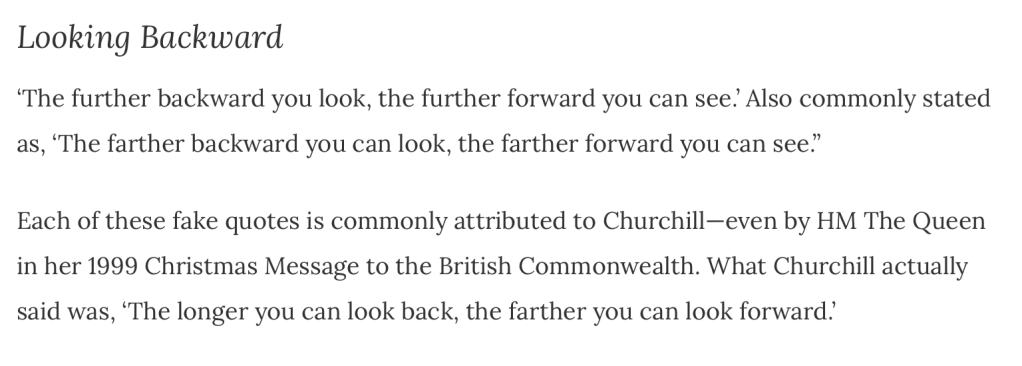
The average man in the United States lives to be just below 78. It is pretty depressing. Existential thoughts aside, we must carry on. How many unique champions has a man aged 78 today seen? I figured this is a fair way to think of the question. A lot can change in the course of nearly 8 decades and as Winston Churchill once said, “The longer you look back, the farther you can look forward.” (As an aside, the International Churchill Society website is very sassy about how this has been misquoted before)1. So since we are in times that may be hard to see what is on the horizon, the only thing we can do is to look back and try to get an idea of what is to come.
A man who is 78 today has seen 26 unique National Champions which is certainly more than my 14 but still not that many in the grand scheme of things. In that same time, he has seen every NBA Champion and there have been 21 of those in a much smaller pool of teams. 12 new teams.
3. ChatGPT
So I am not the biggest proponent of AI. I think we should leave making art up to humans since that is how new things can be created whereas with AI, it can only copy what it has already seen. I do think it has its uses and that, when used correctly, it can help out in a multitude of ways but like anything, discretion must be advised as it uses a lot of resources. For those of you counting at home, that is the second soapbox that I have tripped over in this post.
With that being said, I did ask ChatGPT 1 question and that was to predict the next 50 National Champions and this is the list of schools it came up with (along with the amount): Georgia (6), Alabama (6), Michigan (6), Ohio State (5), Texas (4), LSU (3), Oregon (3), Florida State (3), USC (3), Penn State (3), Clemson (3), Texas A&M (2), Oklahoma (2), Notre Dame (2), and Washington (1). Our friend GPT was sparse with the reason as to why they thought these teams would win. Instead, they offered story boards to go with their answers like “Notre Dame remains independent or aligns lightly, winning a couple during strong QB-coach years” and “A dark horse like Washington sneaks in once the playoff allows for deeper runs from the Pac-12 remnants or Big Ten West.”
The little information that they did cite was that teams with the best current rosters and recruiting, mostly in the SEC and Big 10, had the edge going forward. 5 new teams.
4. My own equation
When I started this journey to find my answer, I always knew I would try my hand at putting together some formula to solve the problem. I thought long and hard about what a good key indicator would be for this and it led me to 4 things (4 is the magic number today I guess).
First, a team should be in a Power 4 conference. Teams in better conferences have a better chance at landing higher talent and outside of UCF, we haven’t had a team currently outside of the Power 4 win a championship since 1945. I did not weigh the conferences the same either. Members of the ACC got 30,000 points (it’s a lot but just keep reading). The Big 12 got 20,000 points each. Boise State, Washington State, and Oregon state all got 10,000 points each because of their brand recognizability. To round it out, members of the Big 10 and SEC got 50,000 points a piece. I don’t like that those two conferences dominate but that is the reality that we live in at the moment.
Second, winning a championship in the past (since 1936) means you are eligible for points. I took the amount of championships each school won and multiplied it by 10,000. For example, Alabama has 13,000 points for this section, USC has 7,000, so on and so forth. Simple.
Third is weeks spent ranked. As disputed as the AP Poll is, it is undeniable. When you watch games on TV, you see the ranking right next to the team. It’s the best advertising you could ever want as a school trying to recruit higher talent. When people see that you’re ranked, and have been for a long time, your star only rises.
This one is a little more complicated though. For this metric, I take the amount of weeks spent ranked, I multiply it by 0.1 and then I raise it to the third power. Example, NC State has been ranked for a total of 191 weeks. I multiply it by 0.1 and get 19.1 and then I cube it (19.1)3 which gives them 6967.871 points. The thought behind this is that a lot of teams have been ranked and I felt that, if you show up on the rankings a lot, you should be awarded proportionally.
Fourth is weeks spent at #1 in the AP Poll. What’s better than being ranked? Being ranked #1 in the country. I wanted to add this because there are levels to this. Just being ranked is not good enough to win a National Championship. Winning a National Championship means that there was no one in the country that could compete with you. Undisputed. Bar none. We saw this clear as day in this past College Football Playoff. None of the first round games were particularly close (except for the Texas/Clemson game, but that furthers my point). Being ranked 1st and being ranked 17th are completely different and I wanted to make that distinction. I did the same thing as the previous metric but instead of multiplying the appearances by 0.1 I multiplied them by 0.5 and then cubed the result.
Before I continue, I just wanted to briefly mention some other things that I considered for this equation. Two metrics that I considered were recruiting rankings and draft picks. Why I decided to go without the recruiting rankings is, just because you recruit well, doesn’t mean that you will play well. The 2022 Texas A&M recruiting class is regarded as the best of all time and it resulted in zero National Championships. They never even made the playoff. Also in this day and age with the transfer portal, you can recruit a 4-star, they could get redshirted (sit out but retain their eligibility for that year) in their first year and then transfer the next Spring and they would never play a down for your school.
The reason I did not include draft picks is because I felt that they were more of a product than a cause. It’s no surprise that after a team wins a National Championship, they usually lead the draft in players selected. If you’re selecting players in the 5th, 6th, or 7th rounds, you are probably more likely to look at a guy that was on a championship team, played meaningful snaps late in the season, and is clearly coachable above someone who went to a Group of 5 school.
With that out of the way, I can feel the question already. “Garrett, what did you do with all the points?” If you find yourself asking that then you’re going to love this next part, I added them all together and got a huge number. Pretty cool I know. So I took all the points that each school got for each category and divided over the sum total of all points gained:
(AP Poll Appearance Score + AP Poll #1 Appearance Score + Conference Score + Championships Score)/(Sum of all scores by every team across all metrics)
This number gave me a probability of how likely (in my humble opinion) a team is to win a National Championship. For example let’s look at a school like Maryland. They have 1 National Championship, 193 appearances on the AP Poll, 6 appearances at the #1 spot, and they are in the BIG 10.
Appearance score = (193 * 0.1)3 = 7,189.057
#1 Appearance score = (6 * 0.5)3 = 27
Conference Score = BIG 10 = 10,000
Championships Score = 1 * 10,000 = 10,000
Total Score = 67216.057
That total score for Maryland was put over the total score for every team which came out to 13,340,560.101999998. So when you divide Maryland’s score by every team’s score you get 0.005038 which means in any given year, the model gives them a 0.5038% chance to win the National Championship.
This model only involves teams who have made the AP Poll since 1936 and thus, only 115 teams made the cut. Unfortunately, if your team has never been ranked, you have no chance (My UB Bulls have been ranked only 3 times and are tied for the second worst odds in the model, but we technically have a shot!)
After getting every team’s percent chance of winning it all, the only thing left to do was to get a randomizer and have it select teams based on those percentages. Here are the results: Alabama (7), Ohio State (6), Notre Dame (5), Oklahoma (4), Auburn (2), Clemson (2), LSU (2), USC (2), Vanderbilt (2), Arizona State (1), Florida (1), Florida State (1), Georgia (1), Kentucky (1), Michigan (1), Mississippi (1), Nebraska (1), Oregon (1), Penn State (1), Syracuse (1), Texas A&M (1), UCLA (1), and Wisconsin (1).
The first thing that jumped out to me were the teams that won 2 each. Clemson, LSU, and USC each winning 2 in the next 50 years would not surprise me. It wouldn’t surprise me if any of those schools won more. However, Vanderbilt and Auburn both winning 2 a piece kind of shocked me. In my model, LSU is 10x more likely to win a National Championship than Vanderbilt so I can’t explain it.

Another takeaway would be that no champion is a Group of 5 school and, outside of 5 schools (Clemson, Notre Dame, Florida State, Arizona State, and Syracuse), all schools chosen were from either the SEC or the BIG 10. That may sound excessive, but since the 1991 season, only 4 teams not currently in those conferences have won a National Championship (Clemson, Florida State, Miami (FL), and UCF). That’s 33 years with mostly current BIG 10 and SEC National Champions so in my model where it’s 50 years with only 5 others seems to be about right.
If I were to change the model I think I might have weighed current success more than older success. The model picked both Michigan and Nebraska once which probably isn’t likely given that Michigan won a championship a year ago whereas Nebraska hasn’t won one since 1997. In this case, I would have weighed the recent championships heavier and then when the model picked someone as champion, I could then change the data to add the new champion and rerun the model with the new odds. This could lead to one team getting picked a bunch but given how large the numbers got and how small the percentages were, it probably would not have been too much of an issue. 12 new teams.
So maybe we’ve found the answer to my question. I will see between 5 and 12 new championship teams for the rest of my life. Selfishly, I wish it were more but hey, what can you do?
Chaos Scenario
There is actually one more thing that I wanted to talk about before the end of part one. This is an alternate future which hinges on the College Football Playoff changes as well as conference expansion. The way the College Football landscape looks at the moment, conferences are getting larger and conferences are arguing auto-bids into the CFP. One proposed change to the playoff would include the BIG 10 and the SEC getting 4 spots each, the BIG 12 and the ACC both getting 2 spots each, a spot for Notre Dame if they are good enough, and a spot for the Group of 5 champion. This is called the 4-4-2-2-1-1 model.
Now because conferences are getting bigger, teams do not play everyone else in their conference. This means that it is possible for more than one team to go undefeated in the same conference. If the ACC or BIG 12 schedules line up correctly, technically they could each have 3 undefeated teams but only 2 could make the playoff. This could lead to more unique teams claiming a National Championship due to never losing, but missing the playoff.
This is an absolute chaos scenario and in this scenario, the committee would more than likely just put in the undefeated team over the likes of Notre Dame or the best Group of 5 school. It is not impossible, however, since we have seen the committee leave out an undefeated team from the ACC before. So is this technically possible? Yes? I think so anyways. Is it likely to happen even once? Probably not, but it does highlight the pitfalls that can arise when conferences get bloated and the people in charge only want what is best for those with the most to gain and fans get left behind.
To Be Continued…
For fans of the teams that I have mentioned above, congratulations on your past and future success. For the rest of us, good luck!
While doing research for this post, I ran into a bunch of crazy things pertaining to the National Championships. Specifically older claims that can be confusing to someone who was not well versed in the subject like myself. So in the much alluded to part 2 of this series, I’ll be diving into championship claims throughout history and the people that have made those claims possible.
Just wanted to give credit to the sites where I got my data from. All National Champions came from the NCAA website (https://www.ncaa.com/news/football/article/college-football-national-championship-history) and the AP Poll historical data came from the “College Poll Archive” (https://www.collegepollarchive.com/football/ap/appearances-total.cfm).
You see what I’m saying? It’s quite sassy. It even takes a shot at the Queen and she’s dead!


Leave a Reply