By: Garrett Kilcer
In this post, I will talk about the introduction of the salary cap and how important it is to play your best player the big bucks.
Why am I Pocket Watching?
When I was younger I would hear NBA players talk about how some of their teammates didn’t really love the game of basketball. They would say that these players would get drafted into the league and not put much work in to get better, coast off of their previous achievements. As a younger man in his developmental years, this rhetoric was unfathomable.
I love the game of basketball and I played a ton of it growing up. I wanted so desperately to get better, taller, faster, and stronger so that I could play more basketball. Unfortunately I stopped growing at 5 foot 11 inches (and a real 5’11” not Hinge 5’11”) so that dream had to be put on the shelf along with becoming a paleontologist. Now, when I think about those NBA players who show up year in and year out, collecting a paycheck but not getting any better at their jobs, I understand. For the record, I would never show up to work and give less than my 100% effort; however, I understand if someone might.
Money is a part of the NBA that I did not care much about when I was coming up through grade school. I knew the players were paid obviously, but let’s just say when Dwight Howard signed with the Lakers in 2012, player contracts were not top of mind.
Now when free agency or a trade goes down, one of my first thoughts is to go to Spotrac.com and check to see the cap flexibility of the team or teams in the deal. I feel like you can get a good read on what a team might do given how much money with which they have to operate. Take the Wizards for example. They went into the 2025-26 NBA season with two large contracts set to come off the books at the end of the year in C.J. McCollum and Khris Middleton. That was a good indicator that they were either going to spend a lot of money in free agency at the end of the year or they would use those contracts to trade for other big contracts on longer deals.
It is with this new found fascination with the business side of the NBA that I turned my sights to an analysis on how spending top dollar for players impacts winning. I looked at the highest paid players each season since the salary cap (the amount of money you are allowed to spend on your roster each year) was created and compared it to their winning percentage and to the highest paid salary on the team that won the championship that year.
(As a Lakers fan I must mention that the Celtics have only won 3 championships since the salary cap has been created while the Lakers have won 9)
Before we get into the data, I must offer some explanations for the data.
- In the 2004-05 season, ESPN lists the highest paid player on the San Antonio Spurs as Glenn Robinson while all other outlets I have seen have it listed as Tim Duncan. I went with Tim Duncan since it made more since given the salaries he was making in the years around then.
- In 2009-10, the same thing happened where everyone said it was Tracy McGrady while ESPN said it was Kobe. I went with T Mac.
- In 2011-12 and 2012-13, LeBron James and Chris Bosh both made the same amount of money when they won their championships with the Miami Heat. I decided to go with LeBron
Salary Cap and Highest Paid Players through the years
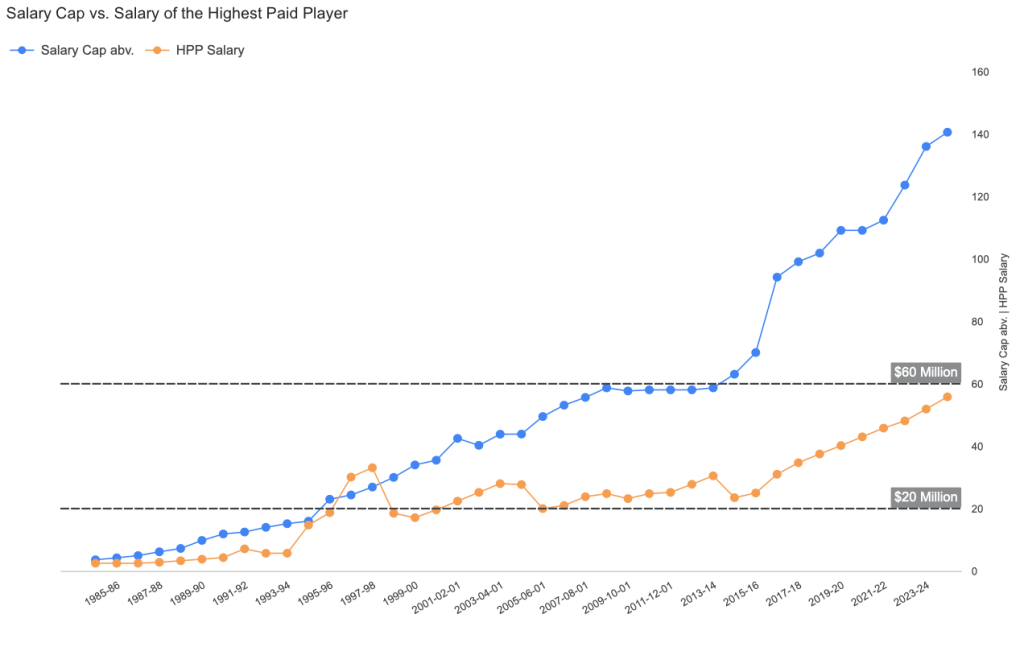
Above is a graph that charts the NBA salary cap in millions (blue) against the salary of the highest paid player in the league (orange). If you have eyes, there should be two trends that jump out to you instantly.
The first thing you might see when looking at the graph is the dramatic increase in the salary cap over the last decade or so. This can be attributed almost entirely to one person and that person is the commissioner of the league, Adam Silver. Profitability of the league has spiked under Adam Silver which has allowed teams to spend more since their owners are making more. Whether or not Adam Silver has been good for the league is a discussion for another time but in the context of the piece, it has allowed players to make more money (which is good).
The second thing (or the first thing if you read the graph left to right I guess) that you probably noticed was that there are two years in which someone made more money alone than the team was allowed to spend for everyone on the roster. That person was Michael Jordan. Dan Lust writing for LVSportsBiz.com has a great breakdown of it here (https://lvsportsbiz.com/2020/05/18/on-sports-law-how-michael-jordan-and-bulls-last-dance-changed-nbas-salary-structure/) but the basic gist of it is that, in order to incentivise players staying with the team they were currently on, those teams were allowed to sign these players back for as much money as they wanted. They eventually patched over this loophole but a version of this rule still exists today where a player’s current team can offer them more money than they can get elsewhere in free agency.
Who Were the Top Dogs?
Let’s look at some of the players that were at one point the highest paid in the league.
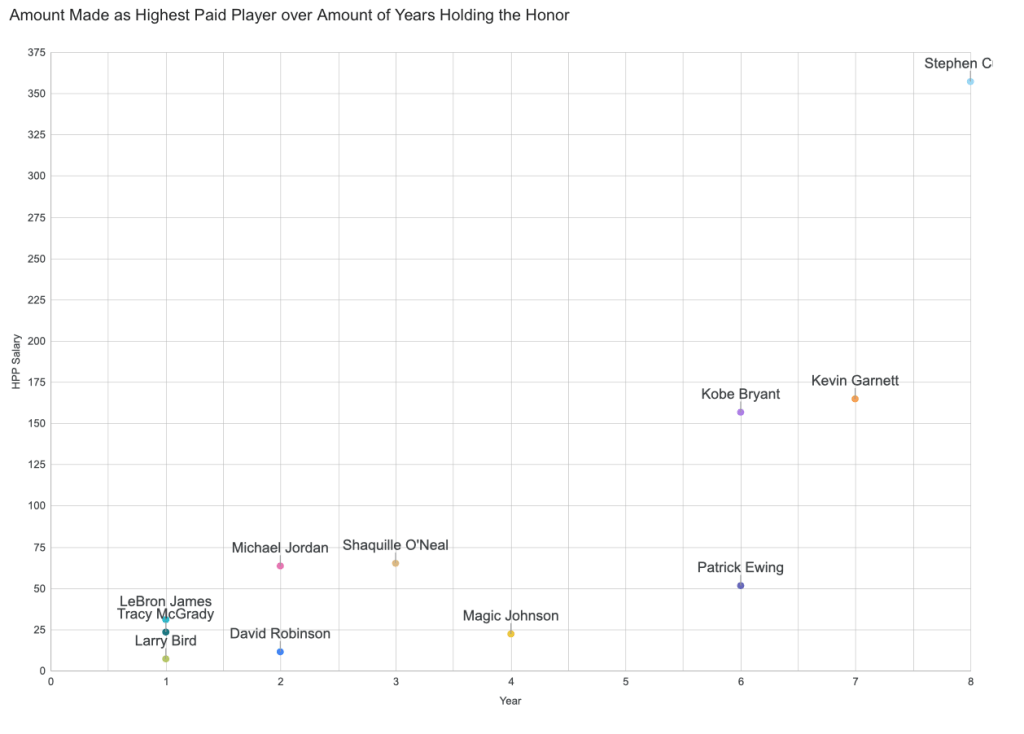
Like we talked about above, the players that mostly stayed with one team, litter the right side of this graph. Loyalty is rewarded in the NBA. Curry, Kobe, Ewing, and Magic all made a bulk of their earnings all playing for one team. Kevin Garnett is a little different because he signed his record deal while on the Timberwolves and then was traded to the Celtics where he finished off that contract.
For many of these guys, the contract that put them on top was a result of winning championships. Jordan, Magic, Kobe, Steph, and Bird all got their big money only after winning championships with their teams. Kobe started his streak at the top after his 2010 Championship while Steph started his after his second win with Golden State.
Another thing that I thought was interesting was the location of the teams that were doling out this money. Of the 41 years of data, in 33 of those years it was one of these cities that was doing the spending: Los Angeles, San Francisco, New York, Chicago, Boston, and Miami. Could it be the case that teams in these markets are willing to spend more to keep talent in house because they know they can recoup that wage in ticket sales or merchandise compared to a city like New Orleans? I think it’s not outside the realm of possibility and perhaps that was the case back in the day when the cap was first introduced but I don’t know if that holds water. The prerequisites that you need in order to be able to attain the highest paid contract is rigorous and it just so happens that it hasn’t lined up for those other teams yet. For example, Shai Gilgeous-Alexander is set to be the highest paid player in the 2030-31 season in Oklahoma City.
There is no “I” in Team (but there is a “me”)
A common thing you will hear in sports is when a star player takes a “team friendly” deal. This means that that player could have made more money but decided to take less so that their team’s front office can use that money to sign other good players. A good example of this would be when LeBron, Wade, and Bosh who all took less money than they could have, to team up in Miami and win two championships. I will put a pin in this and come back to it later after I give more thoughts but in the meantime, look at more graphs.
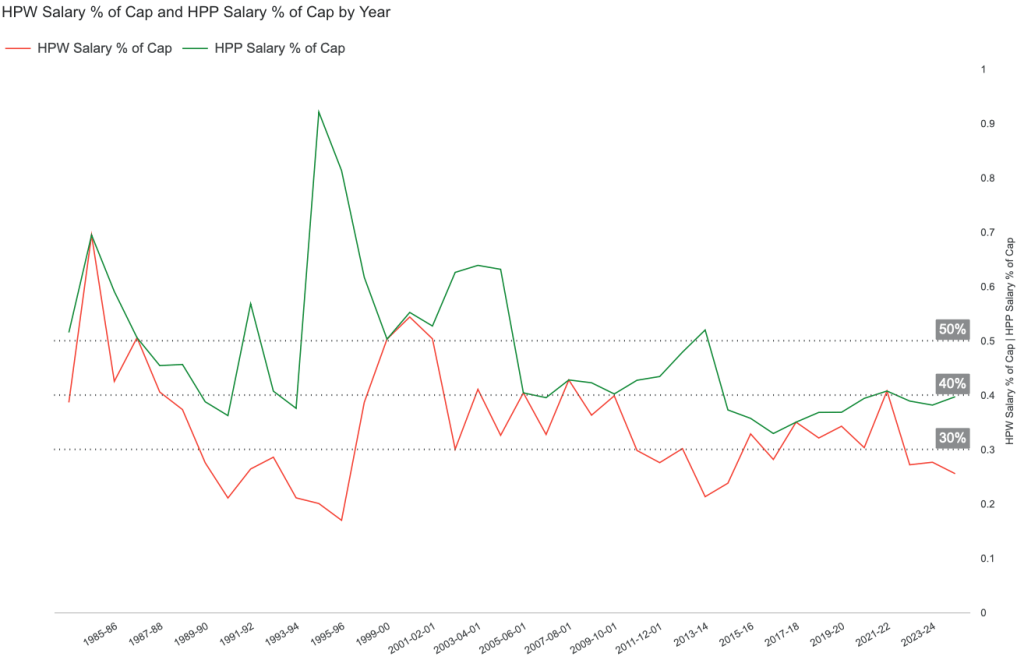
The above graph plots the percentage of the cap taken up by the highest paid player in the league (green) against the percentage of the cap taken by the highest paid player on the championship team (red). The points where the two lines touch are years in which the highest paid player in the league won the championship. This occurrence happened 9 times over the 41 years of data I have. (I took out the two years Jordan made more than the cap to make the chart look better)
For me, what I was drawn to were the stretches on the graph that have the largest delta between the lines. I think these sections say so much about the teams that were winning championships. Teams like the Bad Boy Pistons of the early 90s and the beautiful game Spurs of 2014. Teams that had a star but the roster was built well around them. Maybe your coach was right when they said “teamwork makes the dream work”.
Now here are the 9 occurrences of the highest paid player (HPP) in the NBA winning the championship.
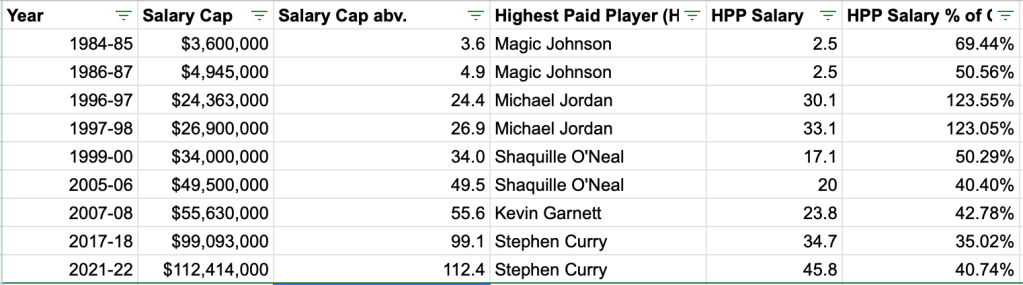
The list is Magic, Jordan, Shaq, KG, and Curry. My take on the “team friendly” deal thing is this: unless you are arguably one of the top 5 players of all time, you need to take a smaller contract if you want to win it all. Magic, Jordan, Shaq, and Curry all have a case to be the best players to ever play their positions and KG was on a super team (not to say KG wasn’t great, he was, but that is just the fact of the matter).
If I were a GM (Please Hire me Chicago Bulls)
So should you pay your best player top dollar? Is it a good investment? I would say probably not unfortunately. Any given year there are probably quite a few guys that could win a championship as the number one option if I am being generous. The only problem is, you need the money to surround those players with the exact fit that works for them. For example, Luka Doncic went to the NBA Finals on the Mavericks with a team that was custom built for him in mind but now he is on the Lakers and they have a hard time figuring out team dynamics.
As much as we like to talk about great players and carrying teams to championships, that isn’t really what happens. The Thunder’s championship last year was only possible because Alex Caruso played incredible defense on Jokic in the second round. Two of LeBron’s championships wouldn’t exist if three pointers made by Kyrie and Ray Allen didn’t go in. Even the people that I listed above who won as the highest paid players, had one or multiple teammates that are currently or will be inducted into the Hall of Fame. None of us can do it alone despite what the talking heads on the television want to make us believe.
Thank you to:
ESPN.com, sportive.com, spotrac.com, hoopshype.com, and eskimo.com

 Superfluous Analytics
Leave a comment