By: Garrett Kilcer
In this post I look into what is going on with the Los Angeles Chargers after the ball is snapped.
Last night I was watching the game between the Los Angeles Chargers and the New England Patriots. As I watched the game, something really jumped out at me and I had to check this morning to confirm my suspicion. Up to that point in the weekend I had watched some amazing football games with huge comebacks and multiple fourth quarter lead changes however; when I watched the Sunday night game something felt off. The pace of play felt lethargic and slow. The offenses felt like they were stuck in the mud and it wasn’t just due to the lack of scoring. The culprit was Justin Herbert and his offense was holding on to the ball too long.
Through the 5 games that have already been played, Justin Herbert held on to the ball longer than any other quarterback in the playoffs with a time to throw of 3.24 seconds per dropback. The only other player this weekend with a time to throw over 3 seconds was Caleb Williams at 3.16 seconds.
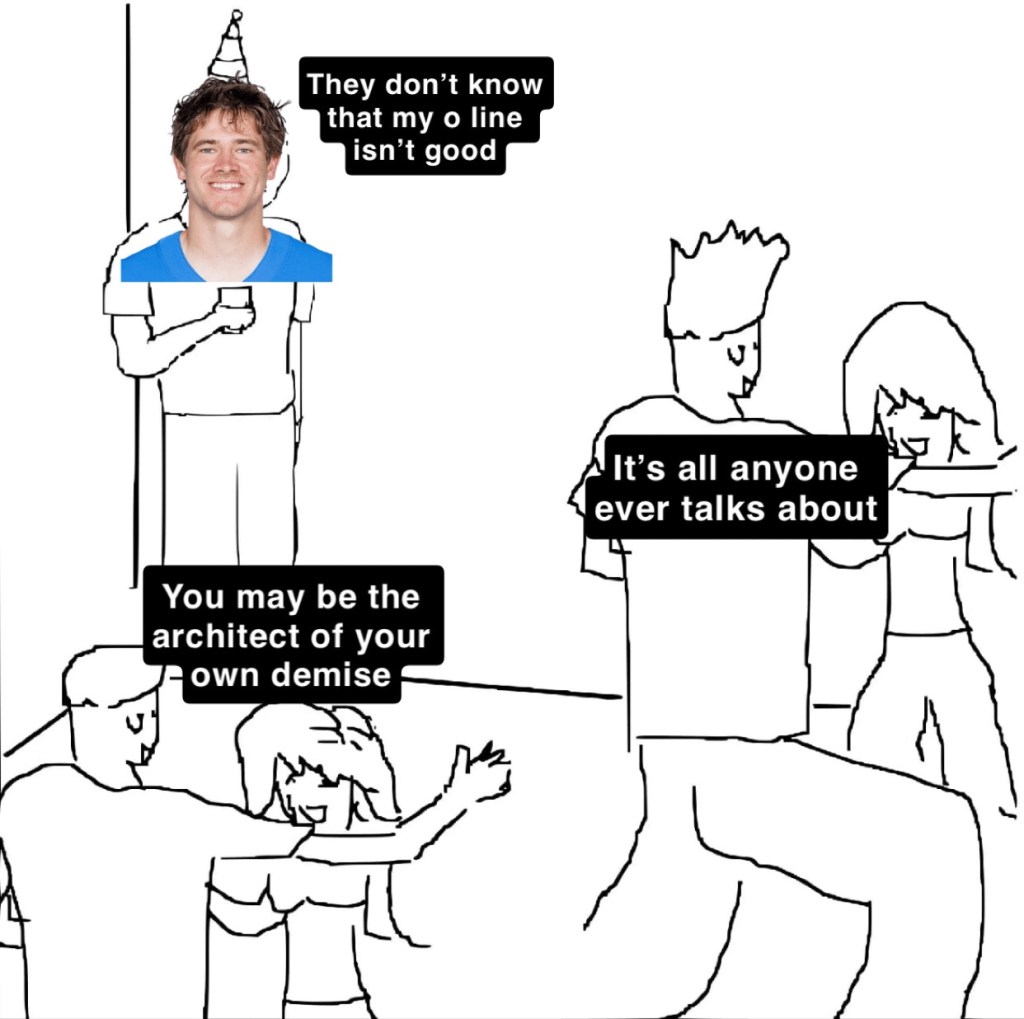
Much has been made about how terrible the Los Angeles Chargers offensive line has been this year. With their former first rounder Joe Alt missing most of the season, it was common to say that Justin Herbert was going out there with his life on the line. When I went looking into the data however, I found some interesting numbers which might square the circle.
My first train of thought here was this: “If Justin Herbert has a bad offensive line and he is waiting too long to throw then that must be because they are running plays that are taking too long to develop and he needs to check down more.” The thinking here was that it must be a coaching problem. If you have a weakness (in this case the offensive line) then you should try to hide that as much as possible. However, when I went looking for his average depth of target, it wasn’t very high. According to Pro Football Reference, the ADOT (average depth of target) of the Chargers was 7.6 yards which is tied for 16th in the league which is smack dab in the middle. So Justin is not exactly bombing it downfield.
My next train of thought was to look at all the games he played in this year and chart the time to throw per game. In wins his TTT (Time to Throw) was 2.9 seconds while in losses, his TTT was 2.94 seconds. This does not seem like a huge switch but when you chart the games not by wins and losses but by the EPA/play (Expected Points Added (negative is good for defense and positive is good for offense)) of the defense, when Herbert plays a top half defense his TTT is 3.03 seconds while against bottom half defenses it is 2.8 seconds. Simply put, Justin Herbert makes slower decisions against better defenses. No shame to the guy obviously. Playing quarterback is hard but when it comes to making decisions, he needs to be quicker against better defenses.
Now let’s go back to the assumption I was operating under going into this, the Chargers have a bad offensive line. It is one of those things that everyone knows so we don’t have to talk about it but I did some digging. First off PFF (Pro Football Focus) is a group that has taken on the job of grading every player in the NFL. This is a difficult job and I do not envy it. With that being said, I sometimes disagree with their conclusions. I am not the only one to have issues with their grades, many current and former players have come out against them and people that work for PFF go online to defend themselves all the time. With all that being said, the Chargers offensive line is ranked as the 30th out of 32 in the NFL.
With this knowledge, it came to my surprise when I saw that when it came to rush yards before contact, the Chargers were tied for 10th in the league at 2.6 yards before contact. Also, when it came to rush yards over expected per attempt, Kimani Vidal had 0.5 yards and Omarion Hampton had 0.66 yards. These are by no means top of the league but whenever you hand the ball off to these two, they are getting down field nearly 3 yards before anyone touches them and they are consistently getting you more yards than you would expect.
To play devil’s advocate (or at least introduce a straw man’s argument) you could say that Justin Herbert has no help. He was third in the NFL in sacks taken and the Chargers were tied for 7th in the league for drops. To the former I would say that, perhaps he is taking so many sacks because he doesn’t get rid of the ball quick enough. Even if he is just throwing the ball away, it is preferable to a sack. Less hits on the quarterback is always a good thing and no yardage is lost when you throw the ball to a position coach on the sidelines.
To the latter I would agree that it is a fact that the Chargers are top 10 in drops in the NFL at 26 but they are much closer to the last place team in the NFL than they are the first place team in that category. The least amount of drops would be the Eagles and Patriots at 13 and the most is the Jaguars at 45. The Chargers drop problem is much closer to the middle of the road than 7th in the league might indicate.
One last thing is the defense. Justin Herbert doesn’t play on that side of the ball but the Chargers had one of the top defenses by EPA/Play this season at -0.09 which is just slightly behind the Cleveland Browns (-0.1) who had someone this year that broke the single season sack record.
My prescription for the Chargers going into next season is to emphasize getting the ball to play makers quicker after the snap and let them get more of the yards. This would make the offense easier on Justin Herbert. The Chargers were one of the worst teams this year in Yards After Catch so if they can get the ball out of Herbert’s hands quicker and give those players room to make a play, it would put less pressure on an offensive line that we are all convinced is bad and it would be less hits on the man you are paying over $50 million a year.
I got all the stats for this piece from the following websites:
NFL Next Gen Stats: https://nextgenstats.nfl.com/stats/passing#yards
https://nextgenstats.nfl.com/stats/rushing#yards
Pro Football Reference: https://www.pro-football-reference.com/years/2025/advanced.htm
Sumer Sports: https://sumersports.com/teams/defensive/
Pro Football Focus (For the O Line rankings): https://www.pff.com/news/nfl-final-2025-nfl-offensive-line-rankings

 Superfluous Analytics
Leave a comment