By: Garrett Kilcer
In this post, I will discuss the Associated Press’ College Football Preseason Poll to determine if the vestiges of that poll find their way to the final poll before bowl season. I know I am like two months late to the discussion but hey, we’re all busy.
What is the Problem with Preseason Polls?
At the beginning of the college football season, the first Associated Press (AP) Poll is released to the public which ranks the top 25 teams going into the season. From the AP website they say that “In recent years, the number of voters has been around 60, and they come from all over the country. The goal is to have every state with a Football Bowl Subdivision school represented by at least one voter, and the total of number of voters from each state tends to increase with the number of FBS teams. There are also spots reserved for national voters.”1 Yes, there is a typo in that, no I did not write it.
The most recent poll featured 66 voters with the consensus being that THE Ohio State was the number 1 team in the country even though they do not have any wins over teams that are currently ranked. Needless to say, not everyone can agree on the rankings put out by the AP.
The first poll of the season, the one in which no games have been played yet, usually catches the largest amount of flack from the populace. Some of this can be attributed to the fact that, since there is no actual football to talk about (and in turn, get mad at) we must all direct our attention to the most football adjacent thing that is within reach and foam at the mouth about it. This flack, while mostly based off of positioning of the teams, sometimes calls into question the legitimacy of preseason polls to begin with. These “Preseason Poll Abolitioners” believe that, since there are no games to go off of, the preseason poll will fill the voters’ heads with preconceived notions about how good a team actually is and it will sway their opinion throughout the season.
This seems like a fair point right? If you go into a season thinking that a team should be in the top 10 and finish the season 8-4 then surely they have the talent and they just caught a few bad breaks. This team is certainly one of the best 25 in the nation because that’s what was thought entering the season.
This was the opening question that I wanted to look into when starting this post, where it eventually ends up… well you’ll just have to keep reading.
So What? Who Cares?
I know I do this every time but before I get into the numbers, I must discuss why. Why does this matter at all? Who cares what some journalists think of the quality of a college football team? Why does this get me so worked up? What dog do I have in the fight?
The answers to the first two I’ll explain now and the answers to the latter 2 are… not important. Unlike the AP Poll which is important to the college football world and especially the teams they rank. The AP Poll is marketing gold for the colleges that are featured within it. While the season is going on (before the CFP (College Football Playoff) Poll comes out later in the season) whenever the school logo appears on the television, their AP Poll ranking appears in hand. It is proof that what is going on at that school is working and that showing this team on your network will bring in viewers.
If I asked you if you wanted to watch the University of South Florida play North Texas, you probably wouldn’t be that interested. But if I told you that the 24th best team in the nation was playing Friday night, that might intrigue you to tune in.
If you’re thinking that viewers tuning into a football game is just a byproduct of football then you are horribly mistaken. The viewers are what the colleges want. Network deals are worth millions of dollars and can influence conference dynamics. Just look at the recent dissolution of the PAC 12. These rankings could also save the jobs of the coaches, influence high school and transfer recruits, and determine which teams play in which bowl games.
I know I have touched on this in previous posts, but it is worth repeating that these rankings say “jump” and the college football world asks “how high?”
The Methodology and the Facts
How did I attack the problem of preseason rankings influencing the rankings later in the season? I grabbed the preseason AP Poll from 2014-2024 and put it up against the AP Poll that was released just after the conference championship games which is usually the first weekend in December. I did this for 2 reasons:
- Things can get wonky when including bowl games because some players sit out to get ready for the NFL and opinions can vary wildly off of one game.
- I can compare these December AP rankings to the final CFP Poll since that one comes out mid season and has no preseason bias baked in.
To be clear, I do not hold either the AP or CFP Poll above the other. I believe that, when ranking college football teams, there is a large amount of grey area that needs to be taken into account so opinions may vary and one may be a more accurate representation than the other in any given year.
What is the purpose of a preseason poll? Is it to try and predict the best teams at the end of the year? If that is the case then the AP Poll should not quit its day job. When comparing the first and last polls of each year from 2014-2024 the best year was 18 teams from the preseason poll on the final and the worst was just 10. Over those 11 polls, the average number of teams that appeared on the first and last of each season was about 14.5. Basically, look at the preseason poll and flip a coin for each team to see if they’ll still be there in December. So far, for the “Preseason Poll Abolitioners” it is not looking so good.
So if the preseason poll does not impact which teams are on the final poll, do they impact their placement on it if they make it there? This is where the CFP Poll comes in.
I compared the final CFP and AP Polls to see where they agreed and disagreed to key in on teams that may have profited from a preseason bump to their rankings. These rankings, just by who was ranked and not their positions in the rankings, are incredibly similar. Only in 2016 did the polls have less than 23 matching schools represented. Out of the 11 years tracked, 6 of them had 24 matching schools and 2 had all 25 schools matching on both polls.
If you are looking to build a case against the preseason top 25, there is evidence there to support your claim:
- 2014: The AP Poll opted for Nebraska at 25 whereas the CFP Poll had Minnesota there instead. Nebraska was in the preseason rankings.
- This same scenario happened in 2015, 2016, and 2017 with Wisconsin, Iowa, and South Florida respectively. Teams that appeared on the preseason and final AP Polls but were omitted on the CFP Poll.
- 2015: Stanford is ranked 5th and Iowa is ranked 6th in the AP while the CFP has them flipped. Stanford was in the preseason AP.
- 2019: Alabama is ranked 4 spots higher in the final AP than in CFP. Alabama was the preseason #2 that year.
- 2021: Louisiana is ranked 4 spots higher in the final AP than in CFP. Louisiana appeared on the preseason poll.
- 2023: Tulane was on the preseason poll and they made the AP final poll whereas the CFP Poll omitted them.
Wasn’t that fun? Cherry picking the data really makes it seem like the preseason poll is still wavering in the minds of voters 4 months after the fact.
I kind of gave it away already because if you are willing to take those data points as fact then, you must also reckon with these data points:
- 2023: Tennessee was in the AP preseason poll but was 4 spots lower than where they ranked on the CFP Poll.
- 2020: Oklahoma State makes the final CFP Poll but misses the final AP Poll despite being on the preseason rankings.
- 2015: Houston was not in the preseason rankings but was 4 spots higher in the final AP Poll compared to CFP.
- 2023: The CFP Poll controversially put Alabama at #4 and Florida State at #5 whereas the final AP Poll had those two schools swapped despite Alabama ranking much higher in the preseason rankings.
- 2024: Missouri was ranked #11 in the preseason poll but in the final rankings, the AP had them 4 spots lower than the CFP.
So obviously someone with nefarious intent could skew the information in their favor to uphold their point in any argument whether they are in favor of the preseason rankings or not. Just to reiterate, I do not hold one ranking in a higher regard than the other.
Favorability Score
This is not where the post ends, not even close. To dive deeper into the comparison between the 2 different final polls. I looked at the difference between where schools were ranked upon the polls. For example, in 2014, Alabama was ranked as the #1 team in the nation on both polls which means they get a favorability score of 0, or in other words no movement. Florida State on the other hand moved from #3 in the CFP Poll to #2 in the AP Poll which gives them a favorability score of 1. This means that Oregon would have to move down one spot, giving them a favorability score of -1.
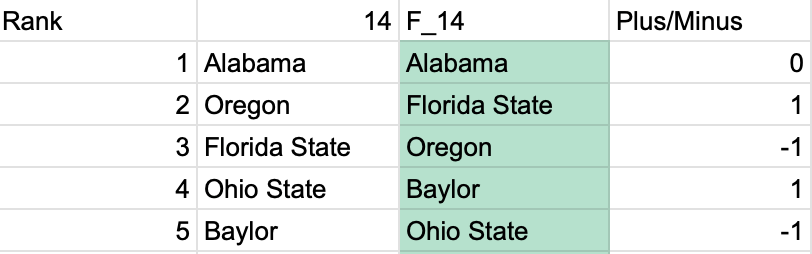
I did this for every year (2014-2024) and if a team appeared on the AP Poll but not the CFP Poll, they were treated as the #26 team in the CFP Poll. For example, in 2017, South Florida was ranked #23 on the AP Poll but missed the CFP Poll so their favorability score was 3. This was done even if multiple teams made the AP but not the CFP, all were treated as a ranking of #26.
I did this originally to see which teams were getting the best rankings from the CFP. Trying to see if big brands really are favored by the committee. To my surprise… they actually were. Not to the largest extent as you may think but the delta was there.
The top team that the CFP committee favors more than the AP Poll is Michigan. Over the 11 years, they gained 7 spots in the CFP Poll when compared to the AP Poll. Next, tied at second, was Iowa and Mississippi with 6 spots; this was followed by Kentucky, Missouri, and (crazy enough) Oregon State with 5 spots each.
These aren’t large numbers especially when dispersed across 11 years. In fact it wasn’t even the largest difference between to 2 polls. Louisiana, over their 2 final poll appearances racked up 10 spots of favorability by the AP meaning the CFP were not all that moved by the Ragin’ Cajuns.
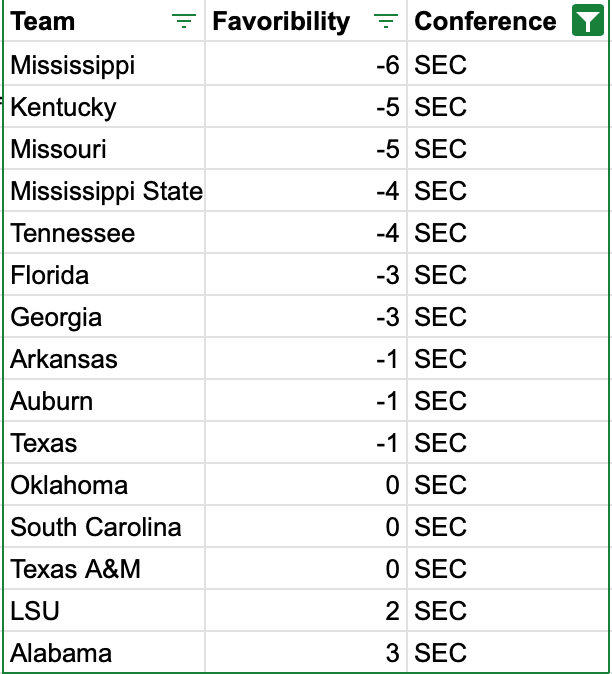
I liked my findings but it left me asking one final question about these final rankings… sure some teams may have moved a couple of spots here or there but what about whole conferences? So I added a column and populated it with each school’s current conference affiliation (I know they have changed during the time frame but big brands have converged so it gets the point across) and I added up all their deltas. Just as a reminder, if the number you get after adding up all the favorability scores is positive, that means the AP Poll ranks them higher. If the number is negative, the CFP Poll ranks them higher. Here is that chart:
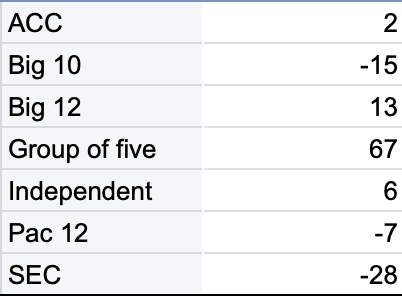
You are not crazy, the SEC does get the benefit of the doubt in the CFP rankings and the Group of five schools are often slighted or left off entirely. Not a single Group of five school has a cumulative negative number over the course of the 11 years tracked.
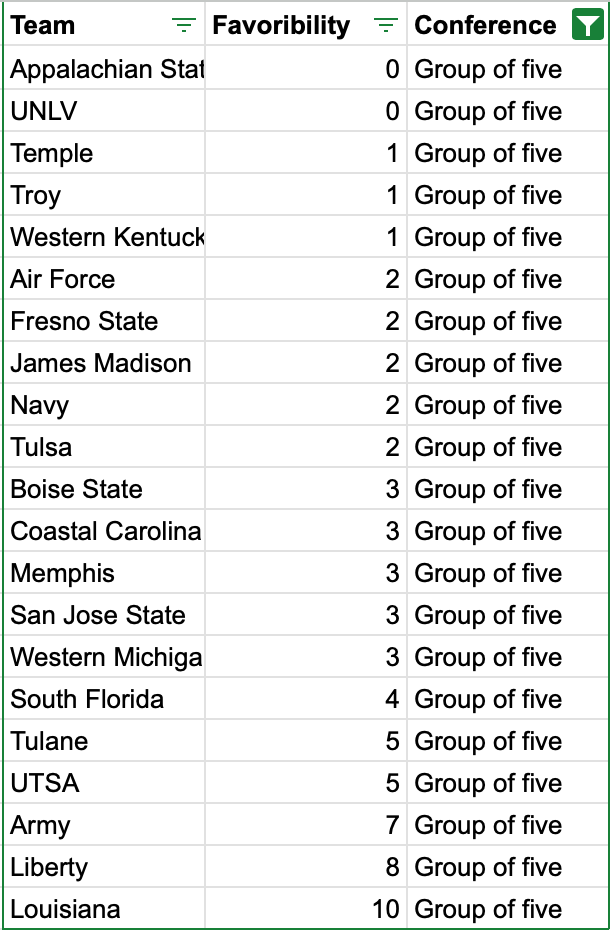
Only 2 SEC schools, over the course of the 11 years, have a cumulative positive number:
The same problem exists in the Big 10 but just not as glaring where, out of the 15 Big 10 schools that have appeared in the final AP Poll over the course of the last 11 years, 5 of them have a cumulative positive score. The biggest brands in the conference, however, (Oregon, Michigan, Penn State, USC) all have negative scores.
The ACC is split right down the middle on favorability with big brands on either side and the Big 12 leans more positive than negative on the whole.
Tin Foil Hat Corner
The conspiracy theorist in me wants to say that, since ESPN owns sole television rights to SEC football and the College Football Playoffs, they are using their power to position SEC schools higher than they deserve. I would say that it would make them look really good if they held the power to the rankings and made sure that the teams that they showed were ranked higher than they should be. This is something that I want to say but… I would be cherry picking evidence.
I would have to disregard the fact that the Big 10 gets helped out by the rankings as well, even though their games are primarily shown on FOX. I would also have to throw out the fact that the ACC, who has a television deal with ESPN until 2036, is more or less unchanged by the CFP rankings.
Is there a grand plot to undermine independent journalists from across the country by ESPN to prop up the schools and teams that they would financially benefit from? Probably not. It is pretty suspicious and when we do see injustice, we must act but, I do not think that is what is going on here.
I would Occam’s razor this whole thing and say that the people on the committee are too busy with their families and working their other jobs where they cannot sit down and watch all 136 FBS teams every Saturday in the Fall. They are, when faced with two teams, picking the one from what is perceived to be the better conference.
Citations and Thank you
- https://apnews.com/article/ap-top-25-1c4c6125a3a3238fb591aa8dbd2beee3, The Associated Press, August 7, 2025
I got my data on the CFP rankings from their website: https://collegefootballplayoff.com/rankings.aspx
I got the data from the historical AP Polls from: https://www.collegepollarchive.com

 Superfluous Analytics
Leave a comment